

By Michael Collins, Teravana
From tax dollars to our backyards, trees can help us cut some of the costs of living. In 1989, the federal Environmental Protection Agency ordered New York to install a new $8 billion water treatment plant for the forests of the Catskill Mountains, a watershed 130 miles north of New York City that provides much of the city’s drinking water. Those not in favor of the new facility offered an alternative option to protect and restore the Catskill watershed for $1.5 billion. The nature-based project protected buffers of landscapes around reservoirs and limited further real estate development, preserving the Catskill forest filter. The story of the Catskill forest is one of an economically sound solution. As a bonus, the surrounding wildlife habitat benefited, paying it forward in a way a water treatment facility never could (Robbins, 2012).
 Putting ourselves in a city like New York, the very place that benefits from a healthy Catskill forest, we find people living in the face of extreme weather events and rising temperatures, with gas and electric bills on the rise, citizens confronted with health risks and associated costs. Most would agree it’s expensive to live in a city, or most places, these days. So, can trees really help us and allow us to save efficiently?
A study by Arbor Day Foundation defines urban forestry as “growing, planting, maintaining, removing, disposing, and studying trees that are usually located in cities, towns, and other human settlements and that are used primarily to meet needs and enable activities of people.” Indeed, people living on city blocks do not have much control over urban forestry, but the city municipalities do.
Concrete bottles up air, especially on hot summer days, causing it to linger and increase in temperature. Trees can provide cooling and shade, lifting that air, especially on school grounds where children need to spend time outside.
Trees can relieve stress and provide comfort to seasons that get warmer yearly. The value of the school goes up, the energy bills go down, and medical bills go down as kids are mentally and physically more healthy and getting more exercise. Taxes go down.
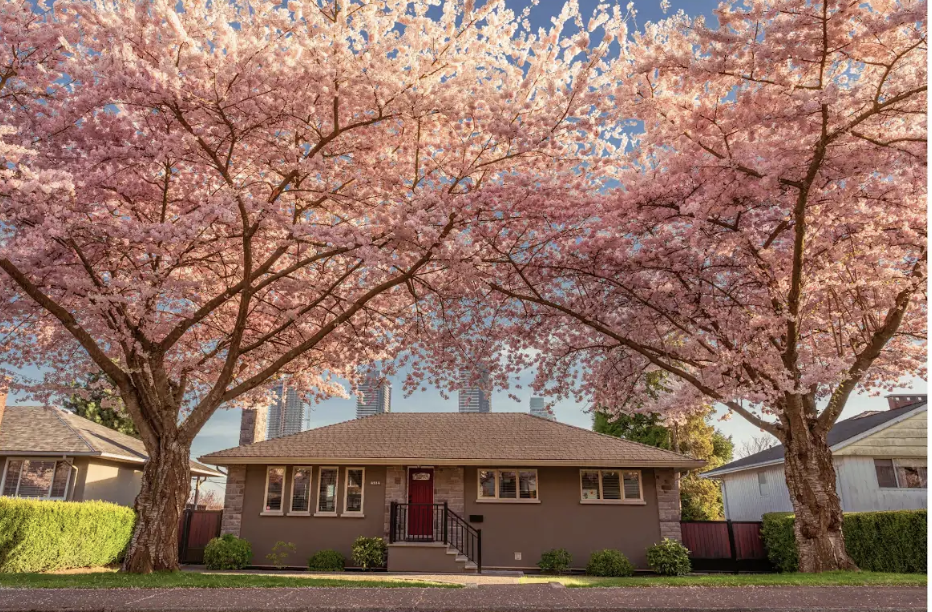
Similarly, in neighborhoods outside the city, maintaining or planting trees can lower summer cooling costs, provide shade and cool asphalt, protect homes from heavy winds, help reduce stress, and contribute to better health and longevity, all adding to property value.
According to the Arbor Day Foundation study, in 2017, tree cover increased the value of homes in the U.S. by $604 billion, provided $31.5 billion of services to homeowners, and $73 billion in added benefits to society in the form of air pollution and stormwater runoff mitigation.
Protecting existing trees, or strategically planting trees, is a way to let nature into urban or neighborhood settings where trees may seem irrelevant or disconnected from the forest. They may be out of their native element, but that is all the more reason to see trees as our allies.

REFERENCES
Economics of Urban Forestry in the United States. Arbor Day Foundation. 2017.
https://www.arborday.org/urban-forestry-economic/
Robbins, Jim. The Man Who Planted Trees. New York: Random House. 2012.